
“Designing for Humans”
As developers, it is easy to get lost in the logic of our code. We optimize for clean architecture and efficient algorithms, but sometimes we forget who we are building for. As we often discuss at Eblix Technologies, we don’t just build products, we build experiences.
Our code defines how users experience a system, meaning every decision from API calls to loading spinners shapes how a user feels about the software.
Here is a breakdown of why understanding UI/UX makes us better developers and more valuable team members.
The House Analogy: UI vs. UX
The terms UI (User Interface) and UX (User Experience) are often used interchangeably, but they serve very different functions. The best way to understand the difference is to think of a house.
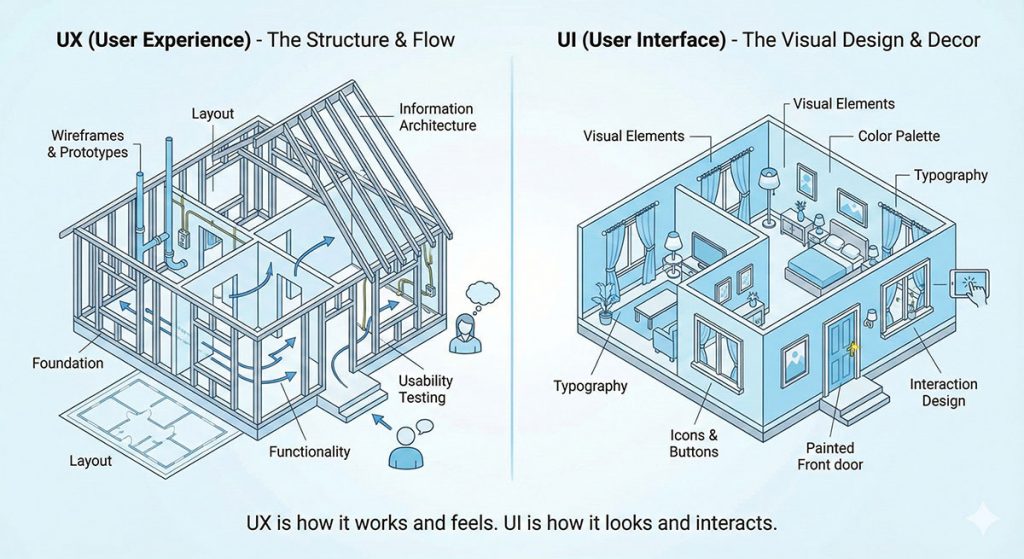
- User Experience (UX) is the Blueprint: It is the logical structure of the house. It asks questions like: Where do the rooms go? How do you get from the kitchen to the bedroom? Is the flow functional and easy to live in?. It is the invisible, logical journey.
- User Interface (UI) is the Interior Design: This is the visual and interactive part. It’s the paint, the furniture, and the light fixtures. It asks: Does it look good? Are the light switches placed in obvious, consistent locations?.
In short, UX ensures the house is livable (Usability, Efficiency), while UI ensures it is beautiful and interactive (Visual Design, Colors, Fonts).
How Developers Can Contribute to Better UI & UX
You don’t need to be a designer to improve the user experience. Here are practical ways we can contribute directly through our code:
- Optimize Performance: Users perceive speed as quality. We can improve this by compressing images and lazy loading data.
- Handle Errors Gracefully: Instead of cryptic error codes, we should display clear, human-friendly messages that help the user recover.
- Maintain Consistency: Follow the design system. If buttons behave one way on the homepage, they should behave the same way on the dashboard.
- Collaborate Early: Review design specs with UX/UI designers early in the process to catch logical issues before they become code issues.
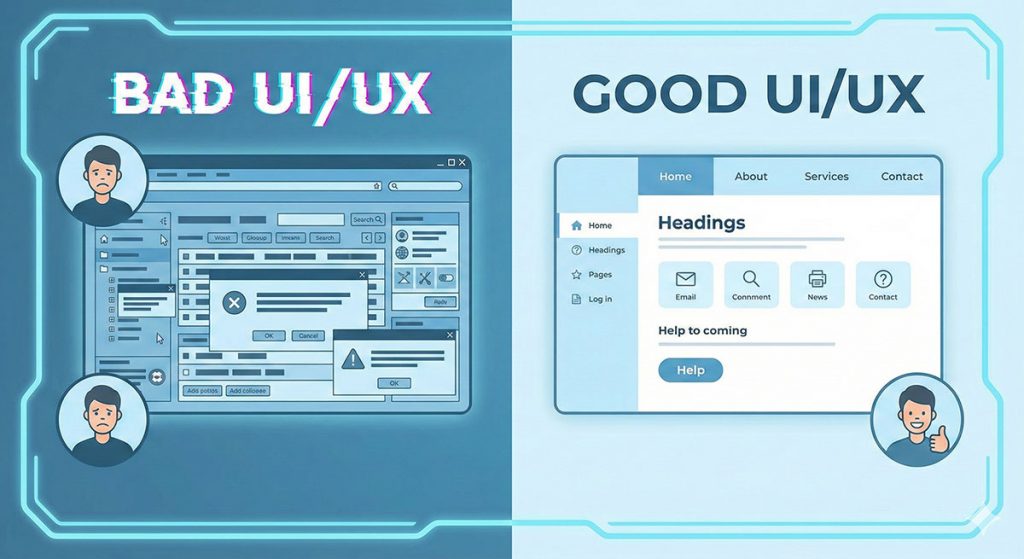
Good vs. Bad UI & UX
Design isn’t just about aesthetics; it has a direct impact on business success.
- Good Design leads to increased user retention, higher conversion rates, and a better brand reputation.
- Bad Design results in high bounce rates, user frustration, and—most importantly for us costly rework.
The Non-Negotiable: Accessibility
Accessibility (a11y) is not an “edge case” or a “nice-to-have” feature. It is a core part of development. Building for humans means building for everyone, including people with disabilities.
As developers, we ensure accessibility by:
- Using semantic HTML (like
<nav>and<button>) rather than generic<div>soup. - Adding descriptive
alttext to images. - Ensuring full keyboard navigation support.
UX is everyone’s responsibility, not just the designers’. As developers, we bring empathy into the code. Our end goal isn’t just working software, but software that works beautifully for humans.
Contact Us for
Ready to Build Software That Works Beautifully?
At Eblix Technologies, we believe that “designing for humans” is the key to software success. We don’t just build products; we build experiences that prioritize usability, accessibility, and efficiency.
We understand that human-centered software leads to higher satisfaction and retention. Whether you need a UI/UX overhaul or a development team that brings empathy into the code, we are here to help you build software that works beautifully for humans.
Contact Eblix Technologies https://www.eblix.com.au/

Miyuni Muthunima
1 articles